Brazil
Lençóis Maranhenses
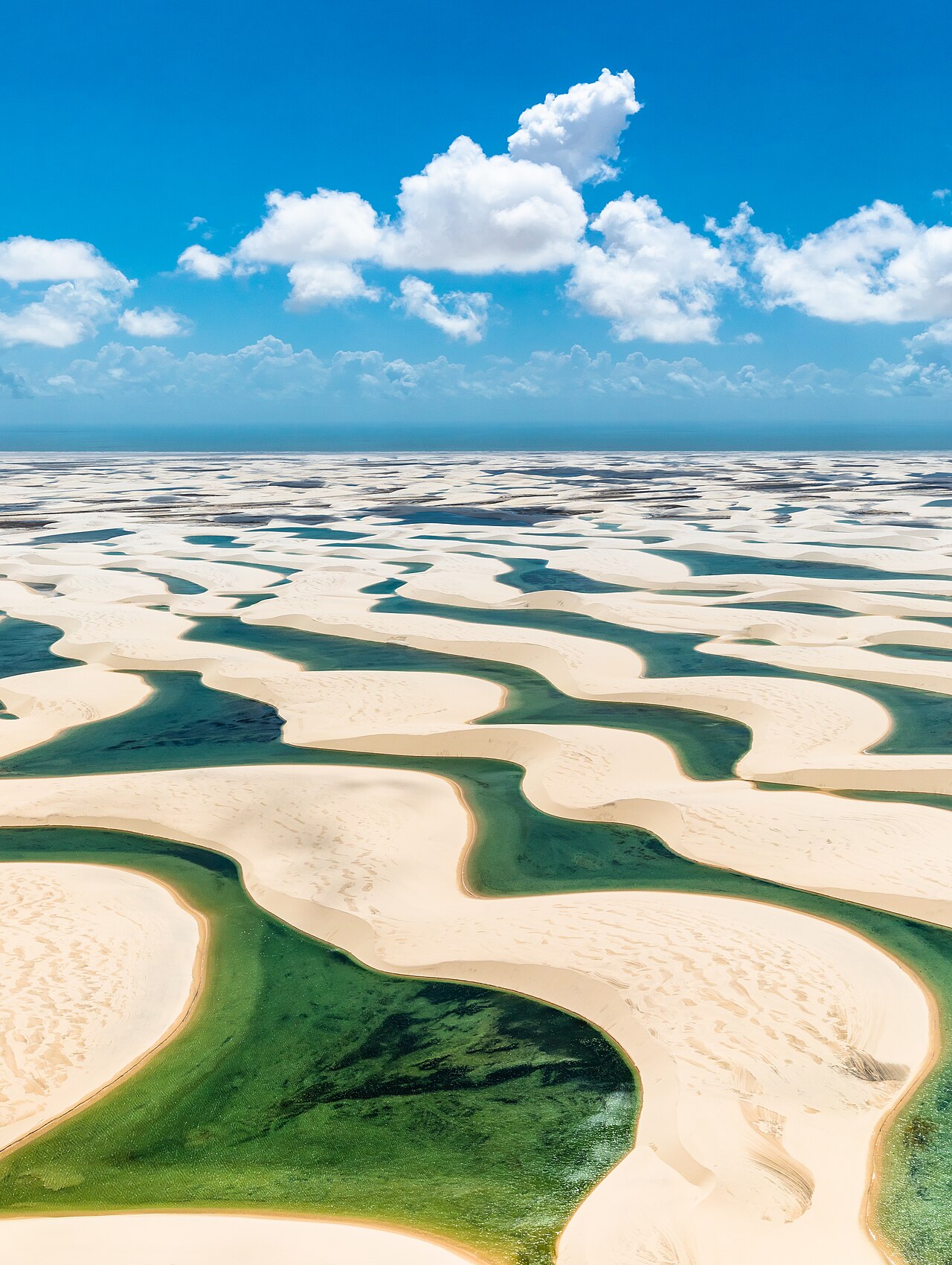
Welcome back to Brazil! Lençóis Maranhenses looks like an endless desert of brilliant white sand dunes, but after the rainy season, thousands of turquoise lagoons appear between the dunes like a giant connect-the-dots puzzle.
Why is it famous?
Its rolling white sand dunes stretch as far as the eye can see, giving the park its name, which means 'bedsheets' in Portuguese.
Between the dunes, rainwater collects into thousands of bright blue-green lagoons that can appear and disappear with the seasons.
How was it formed?
Wind blowing off the Atlantic Ocean pushes sand from nearby river mouths inland, piling it up into dune after dune.
Rainwater collects in the low valleys between dunes because a layer of solid rock underneath keeps it from soaking away.
Amazing facts
The park covers about 155,000 hectares (380,000 acres) of coastline, roughly the size of a small country.
The lagoons fill up during the rainy season, from about January to June, and can grow up to 300 feet long and 10 feet deep.
Quick facts
- The park covers about 155,000 hectares (380,000 acres) of coastline, roughly the size of a small country.
- The lagoons fill up during the rainy season, from about January to June, and can grow up to 300 feet long and 10 feet deep.
- Even though it looks like a bone-dry desert, the region actually gets around 1,200 millimeters (47 inches) of rain a year.
- A special fish called the wolf fish survives the dry season by burrowing into damp mud and staying dormant until the rains return.